Greene's literary framework · independent paraphrase
The idea in plain English
Greene's Natural attracts through qualities associated with unforced play, openness and ease. The role can interrupt a setting in which everyone is monitoring how they appear. It concerns an effect of spontaneity, not a literal return to childhood.
Documented comparison · selected by our editors
An adult makes a room available for play
The Whitney describes Alexander Calder performing his miniature circus for friends and colleagues in Paris. People sat on a low bed or crates, ate peanuts and used noisemakers while he directed the acts and narrated them. The playful atmosphere came from a carefully made performance and invited participation.
I place the encounter near the Natural because ordinary adult self-consciousness could give way to a shared activity. The work was nevertheless designed and practiced. Playfulness does not prove innocence, and the museum's account cannot tell us that every audience member felt the same freedom.
Evidence: Alexander Calder, Calder's Circus, 1926–1931. Source locators and limits are below.
Editorial judgment
What I notice in this encounter
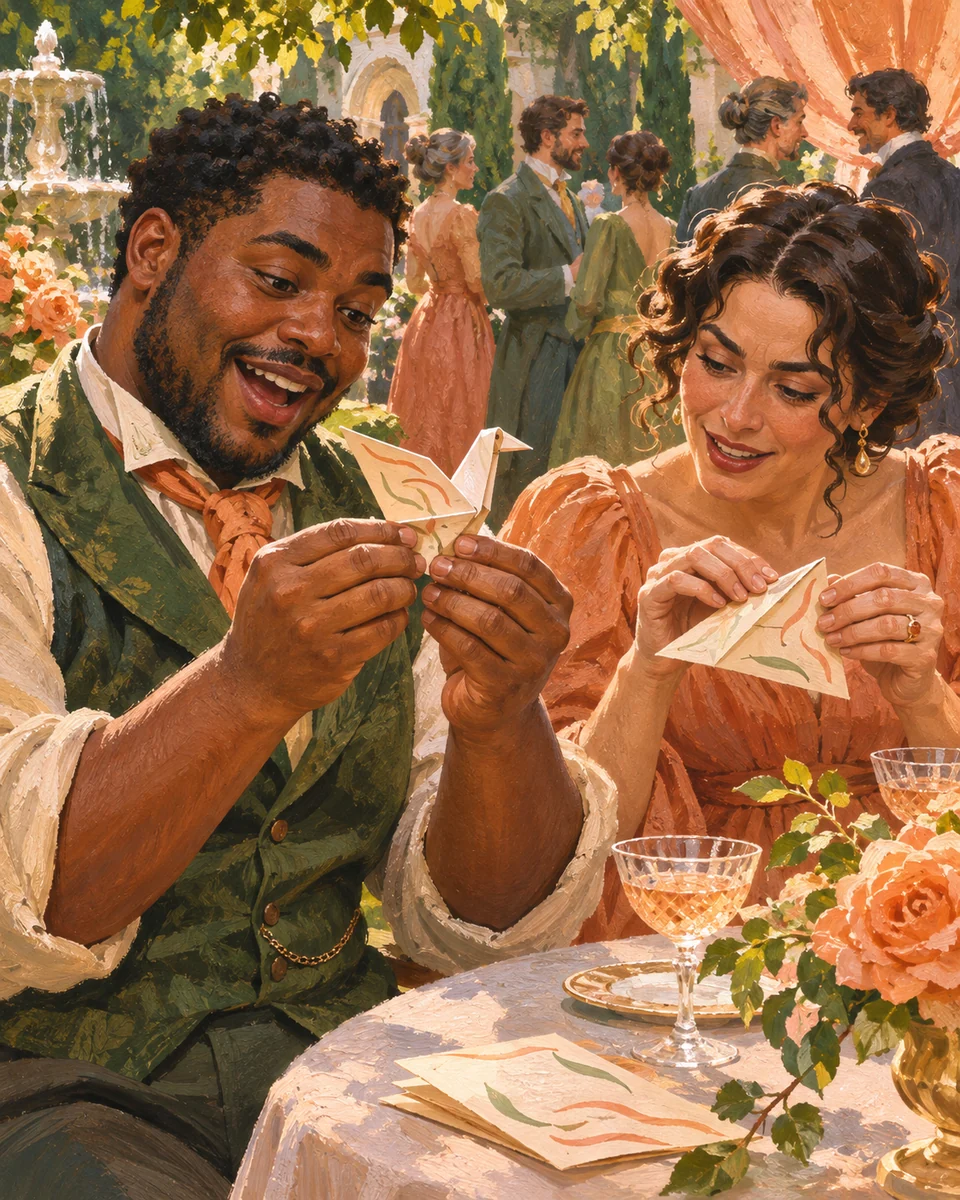
I place the paper bird nearer the Natural when it starts as an absorbing act rather than a carefully targeted service to someone else's comfort. The second person joins because the action creates permission to play, not because the folder has diagnosed their insecurity.
A performance can still be involved. People can practice an easy manner, and an apparently spontaneous joke can have been told before. The more useful distinction is whether participation remains optional and whether the play can survive someone choosing not to join.
Modern illustration · invented adult scenario
A possible scene today
During a break in an adult workshop, someone turns a failed exercise into a quick guessing game. Two others join; a fourth keeps working. The initiator lets both activities continue without making the quiet person defend their choice.
Ease includes the absence of a demand to appear easy. The game offers another way into the group while leaving the group's quieter participation intact.
Where the label can mislead
An adult's playful behavior is not evidence of innocence, honesty or lack of calculation. Those are separate questions that require more than a pleasing impression.
People who need preparation, privacy or a quieter pace are not less authentic. A room's preference for apparent spontaneity can itself become a restrictive social performance.
Sources and edition
The historical comparisons are selected for this publication. They establish particular acts, objects or accounts; the role assigned to a comparison remains an editorial interpretation.
- Alexander Calder, Calder's Circus, 1926–1931
Alexander Calder; custodial interpretation by Whitney Museum of American Art · 1926–1931; collection record undated
Locate: Opening collection description, especially audience seating, peanuts, noisemakers and Calder's narration
Supports: Calder made and performed a miniature circus. Audiences sat on beds or crates, ate peanuts and used noisemakers while he directed and narrated the acts.
Scope: A deliberately made playful performance does not demonstrate a childlike permanent personality or a universal response in its audience.
- The Art of Seduction — publisher record and readable contents
Robert Greene; publisher record by Penguin Books · 2003-10-07 paperback edition
Locate: Publication details; Table of Contents, Part One: The Seductive Character, nine headings before The Anti-Seducer
Supports: The nine seductive-character headings occur in the order Siren, Rake, Ideal Lover, Dandy, Natural, Coquette, Charmer, Charismatic and Star. The Anti-Seducer is separate.
Scope: The contents verify names, order and the publisher's brief propositions. They do not verify the independent historical cases or imply scientific personality categories.
- The Art of Seduction ? Penguin Books, 2003
Robert Greene; produced by Joost Elffers · 2003 paperback; first published 2001
Locate: Copyright page: PDF index 5. The Seducer's Victims—The Eighteen Types: chapter opening printed p.147; Victim Theory p.149; eighteen headings and discussion pp.150–160, PDF indices 177–187.
Supports: The nine seductive characters and eighteen receiving-side headings are separate sets, in book order. The Reformed Rake or Siren is one combined heading. The Anti-Seducer is outside both sets.
Scope: This is a literary taxonomy. Documentary comparisons in the atlas are selected by our editors, not claims that the people permanently belong to a type.