Editorial judgment
What I notice in this encounter
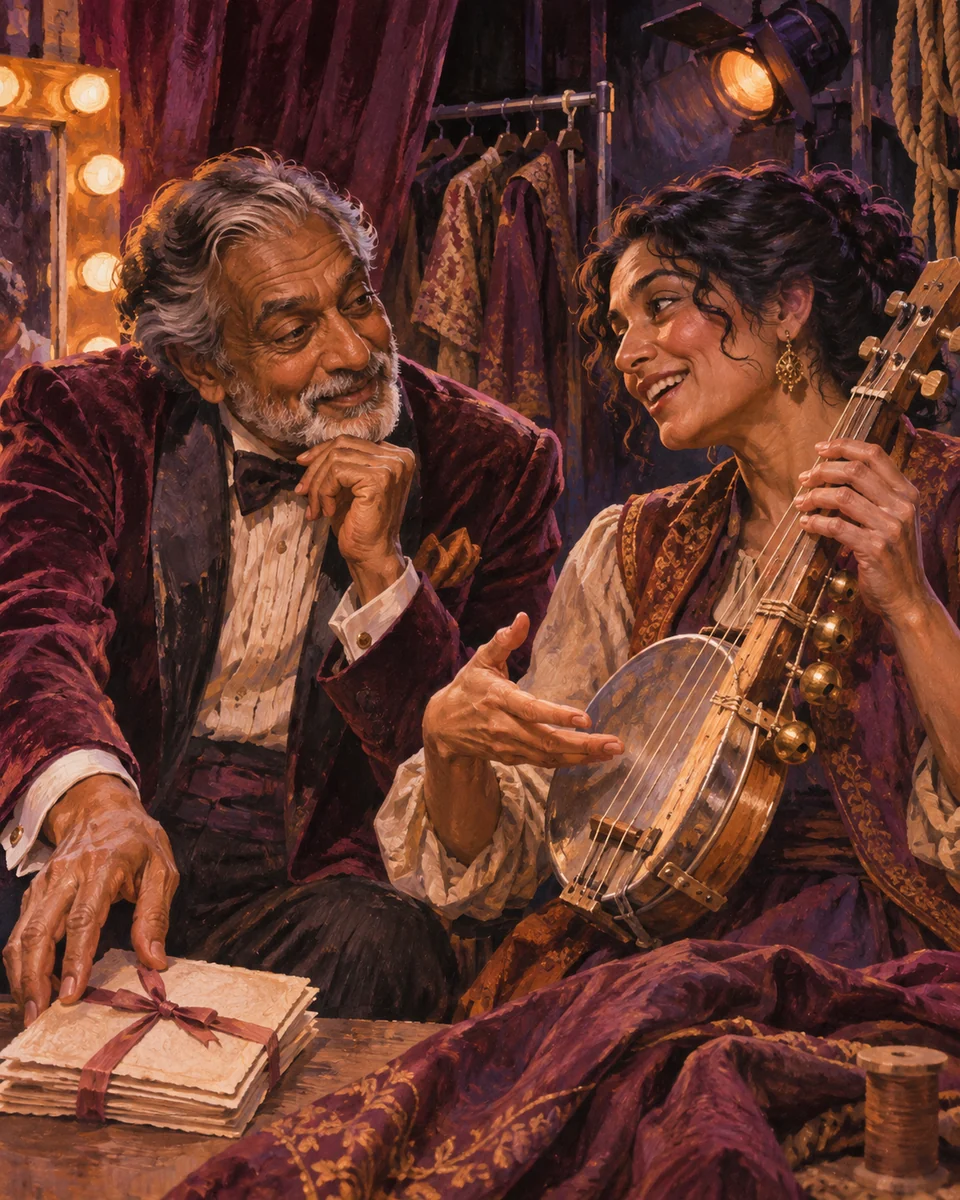
I would distinguish a new performance of innocence from a genuinely specific exchange. The awkward answer in the illustration matters because it responds to the question, not because awkwardness guarantees honesty. An observer can make a cliché out of unpolished behavior as easily as a polished one.
The receiving person can also prefer a practiced manner, an ordinary evening or no encounter at all. A history of experience does not establish an endless need for novelty. Their judgment remains more particular than the role Greene gives them.
Greene's literary framework · independent paraphrase
The idea in plain English
Greene's Roué is a worldly, extensively experienced recipient for whom familiar sophistication may have lost its attraction. An impression of freshness or unpracticed feeling can therefore become unusually noticeable.
“Victims” is Greene's term. This profile reads a receiving-side role in his book, not a permanent kind of person.
Documented comparison · selected by our editors
Worldliness cannot finish the story
The British Library catalogue describes De Profundis as a roughly fifty-thousand-word letter or essay written by Oscar Wilde to Lord Alfred Douglas from Reading Gaol. It also records the later history of shortened and expanded publications. A relationship became the subject of extended writing rather than a single polished public pose.
I use the document's existence as a limit on any claim that worldly experience makes a person simple to read. Its scale invites attention rather than a label. The catalogue alone cannot settle Wilde's feelings, verify every accusation in the letter or explain the whole relationship.
Evidence: Add MS 81645–81647: Papers relating to De Profundis. Source locators and limits are below.
Modern illustration · invented adult scenario
A possible scene today
At an adult literary event, a much-traveled guest is asked to name the most glamorous place they have visited. They answer instead with a story about a repair shop where someone helped them get home. The conversation becomes less rehearsed on both sides.
Specificity interrupts the expected display. It does not prove that either speaker has become innocent or that experience is a defect in need of correction.
Where the label can mislead
Greene's term is historically gendered and carries a social judgment. This reading concerns an imagined pattern of reception, not a moral classification of someone's history.
An appealing contrast between worldliness and innocence can conceal unequal information. Apparent freshness should not be used to excuse an unclear arrangement.
Sources and edition
The historical comparisons are selected for this publication. They establish particular acts, objects or accounts; the role assigned to a comparison remains an editorial interpretation.
- Add MS 81645–81647: Papers relating to De Profundis
British Library catalogue editors; Oscar Wilde manuscript material · Letter 1897; papers 1895–1913 and undated
Locate: Catalogue record 038-001987373, title/description and component Add MS 81645 [1897]
Supports: The catalogue describes a roughly 50,000-word letter/essay written by Wilde to Lord Alfred Douglas from Reading Gaol and its later edited publication.
Scope: This catalogue establishes the document and its form, not every motive, accusation or emotion contained within it.
- The Art of Seduction — publisher record and readable contents
Robert Greene; publisher record by Penguin Books · 2003-10-07 paperback edition
Locate: Publication details; Table of Contents, Part One: The Seductive Character, nine headings before The Anti-Seducer
Supports: The nine seductive-character headings occur in the order Siren, Rake, Ideal Lover, Dandy, Natural, Coquette, Charmer, Charismatic and Star. The Anti-Seducer is separate.
Scope: The contents verify names, order and the publisher's brief propositions. They do not verify the independent historical cases or imply scientific personality categories.
- The Art of Seduction ? Penguin Books, 2003
Robert Greene; produced by Joost Elffers · 2003 paperback; first published 2001
Locate: Copyright page: PDF index 5. The Seducer's Victims—The Eighteen Types: chapter opening printed p.147; Victim Theory p.149; eighteen headings and discussion pp.150–160, PDF indices 177–187.
Supports: The nine seductive characters and eighteen receiving-side headings are separate sets, in book order. The Reformed Rake or Siren is one combined heading. The Anti-Seducer is outside both sets.
Scope: This is a literary taxonomy. Documentary comparisons in the atlas are selected by our editors, not claims that the people permanently belong to a type.