Editorial judgment
What I notice in this encounter
I read the altered costume as a person's authorship of their presentation. That is a narrower and more useful observation than a claim about what their identity makes them want from someone else. The constraints may belong to the room's conventions rather than to an inner lack.
An attentive encounter lets the person describe the change themselves. They might regard it as art, comfort, identity or an experiment without a larger declaration. The observer's wish for a clear category should not overrule that account.
Greene's literary framework · independent paraphrase
The idea in plain English
Greene's original heading addresses dissatisfaction with restricted masculine and feminine roles. His account imagines attraction to an encounter that permits a person to inhabit qualities their ordinary social script discourages.
“Victims” is Greene's term. This profile reads a receiving-side role in his book, not a permanent kind of person.
Documented comparison · selected by our editors
Self-presentation as authored work
Jersey Heritage records that the adult Claude Cahun chose a gender-neutral name in 1918 and collaborated with Marcel Moore on an illustrated reissue of Vues et Visions in 1919. Naming and publication were creative decisions, made within an ongoing partnership rather than awaiting someone else's interpretation.
I read this as authorship, not evidence of a missing half that a seducer could supply. Greene's historical heading should never be mistaken for a modern identity category. This source documents particular artistic choices; it cannot predict desire, erase either collaborator's agency or turn gender expression into a sign of availability.
Evidence: Claude Cahun and Jersey. Source locators and limits are below.
Modern illustration · invented adult scenario
A possible scene today
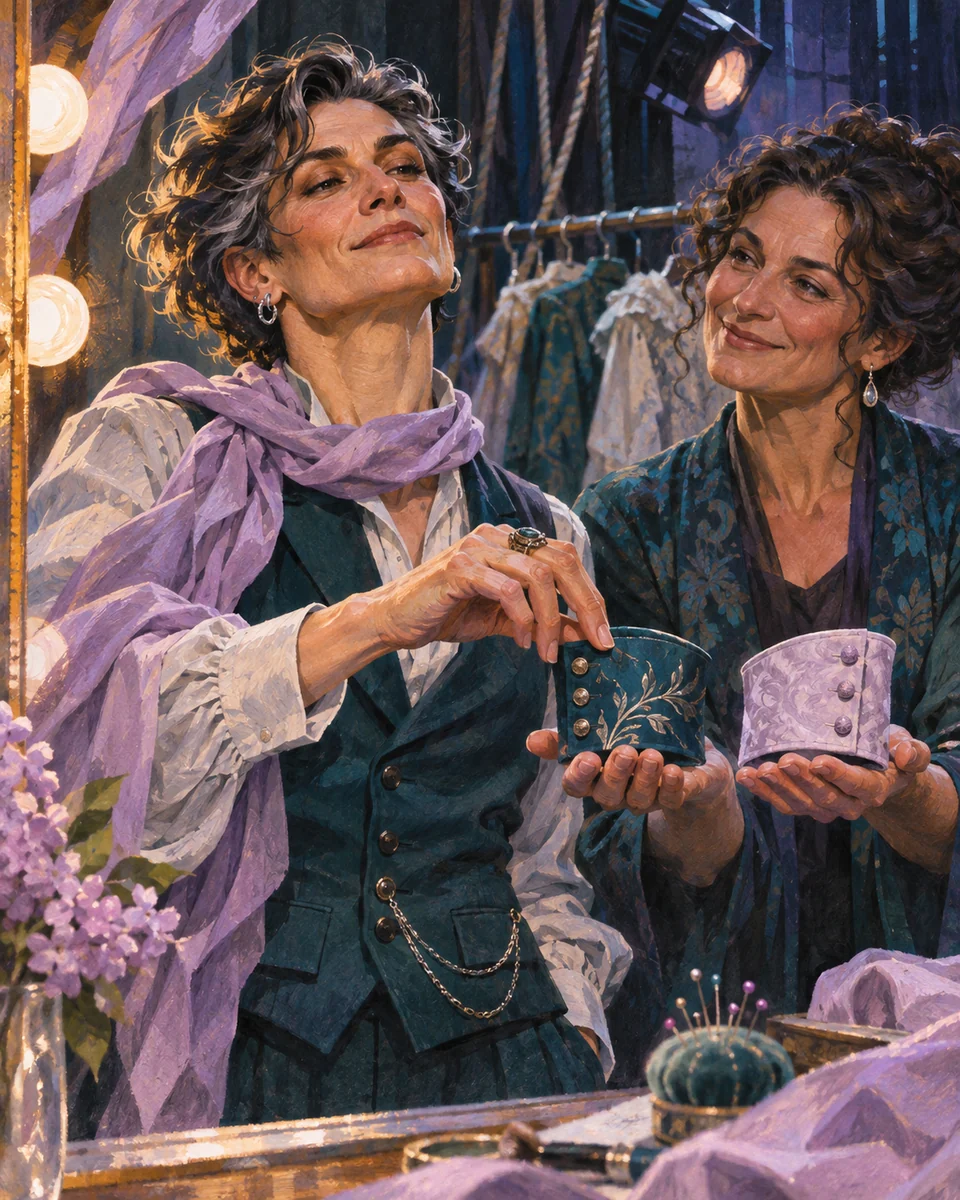
An adult preparing for a performance combines elements from costumes conventionally assigned to different roles. A colleague asks how they want the finished portrait credited, listens and uses the requested description.
Recognition is shaped through a specific request and response. The presentation provides no general inference about romantic interest, availability or vulnerability.
Where the label can mislead
The title is retained as Greene's dated terminology, not offered as a modern identity category. His binary assumptions do not encompass actual ways people understand themselves.
Gender expression and identity are not evidence of susceptibility to persuasion. A literary framework becomes misleading when it is used to predict a real person's private choices from their presentation.
Sources and edition
The historical comparisons are selected for this publication. They establish particular acts, objects or accounts; the role assigned to a comparison remains an editorial interpretation.
- Claude Cahun and Jersey
Jersey Heritage · Undated collection history; adult name/publication choices 1918–1919
Locate: Opening history, chosen name in 1918 and Vues et Visions collaboration in 1919
Supports: As adults, Cahun chose a gender-neutral name and collaborated with Marcel Moore on the 1919 illustrated reissue of Vues et Visions.
Scope: Authored self-presentation and collaboration do not establish a deficit, sexual availability or a predictable response to seduction. Greene's heading is not a modern identity category.
- The Art of Seduction — publisher record and readable contents
Robert Greene; publisher record by Penguin Books · 2003-10-07 paperback edition
Locate: Publication details; Table of Contents, Part One: The Seductive Character, nine headings before The Anti-Seducer
Supports: The nine seductive-character headings occur in the order Siren, Rake, Ideal Lover, Dandy, Natural, Coquette, Charmer, Charismatic and Star. The Anti-Seducer is separate.
Scope: The contents verify names, order and the publisher's brief propositions. They do not verify the independent historical cases or imply scientific personality categories.
- The Art of Seduction ? Penguin Books, 2003
Robert Greene; produced by Joost Elffers · 2003 paperback; first published 2001
Locate: Copyright page: PDF index 5. The Seducer's Victims—The Eighteen Types: chapter opening printed p.147; Victim Theory p.149; eighteen headings and discussion pp.150–160, PDF indices 177–187.
Supports: The nine seductive characters and eighteen receiving-side headings are separate sets, in book order. The Reformed Rake or Siren is one combined heading. The Anti-Seducer is outside both sets.
Scope: This is a literary taxonomy. Documentary comparisons in the atlas are selected by our editors, not claims that the people permanently belong to a type.