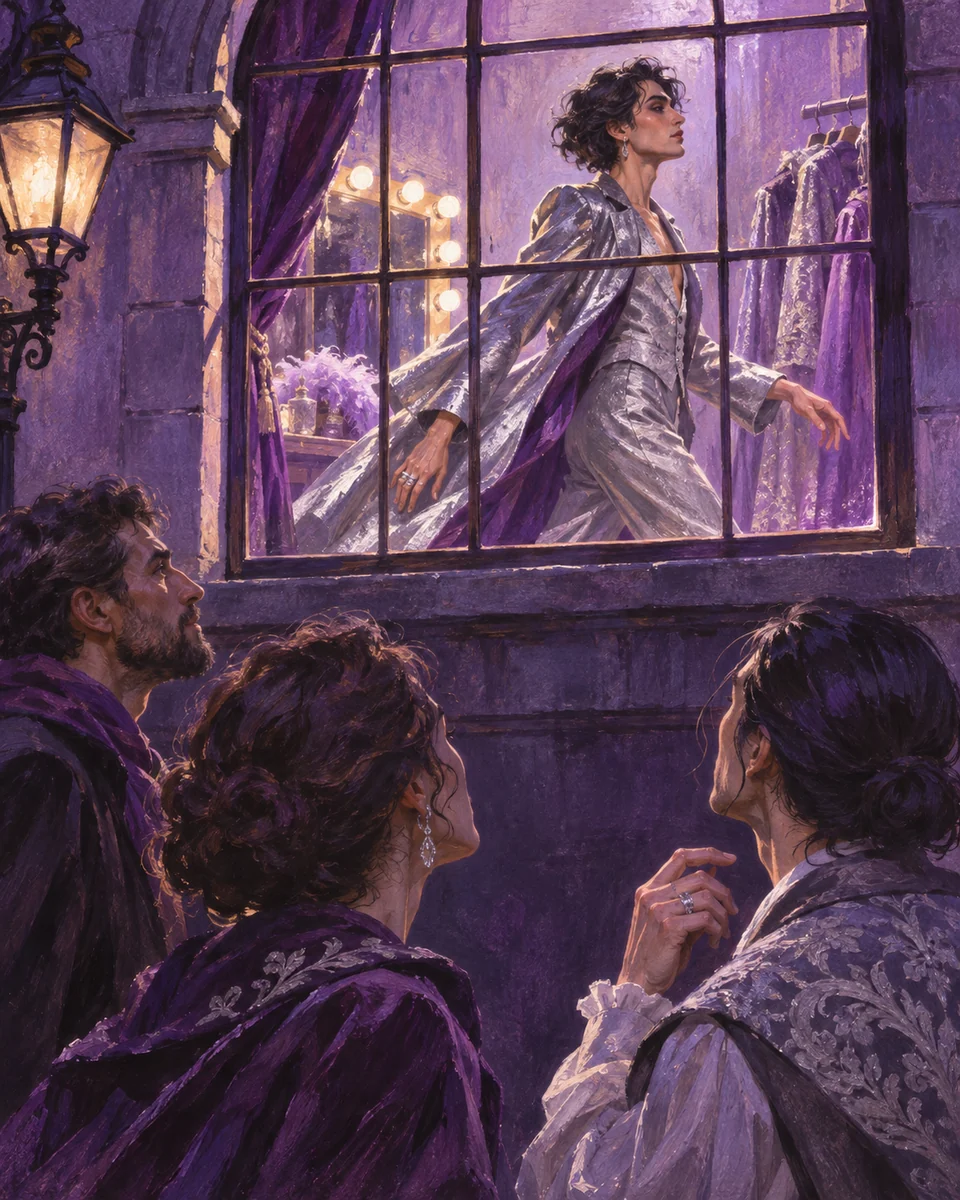
Greene's literary framework · independent paraphrase
The idea in plain English
Greene's Star invites projection through a memorable yet incomplete image. Distance, selective visibility and a striking surface leave the observer room to build a private account of what the person represents.
Documented comparison · selected by our editors
A chosen fragment becomes the public image
National Portrait Gallery curator Rosie Broadley describes Marilyn Monroe's 1959 studio collaboration with Philippe Halsman. Monroe made different jumps in different dresses; a variant was selected for a LIFE cover. The audience encountered a chosen image produced through a performer's and photographer's work.
I place this process near the Star because public imagination receives a vivid fragment rather than an ordinary ongoing acquaintance. The fragment is neither the whole person nor a private invitation. Broadley's account also restores Monroe's participation in making the image, complicating any description of her as simply an object that others invented.
Evidence: The creative collaboration of Marilyn Monroe. Source locators and limits are below.
Shared documentary record · Another reading of this evidence: The Beauty.
Editorial judgment
What I notice in this encounter
I place the window scene closer to the Star because its force depends on what is unavailable as well as what is visible. The audience does not share a sustained encounter with the performer. The gaps become material for imagination.
The person represented can participate in making the image while still being surprised by its reception. A picture that is glamorous to one viewer may be lonely or defiant to another. An analysis that attributes every response to perfect control by its subject gives the subject an implausible amount of authority.
Modern illustration · invented adult scenario
A possible scene today
An adult musician releases a short film built from fragments of rehearsals and a few staged images. Viewers interpret the same silent doorway as a breakup, a new beginning or a tribute. The musician later explains that it was simply the available location.
The interpretations are evidence about reception, not automatic evidence of hidden autobiography. The image has become a shared surface whose meanings are distributed among its makers and viewers.
Where the label can mislead
A public image is not the whole person. Its subject can object to an interpretation, change their presentation or choose not to turn private life into further material.
Attention generated by distance does not tell us how a sustained relationship would feel. Ordinary acquaintance supplies information a projection can comfortably omit.
Sources and edition
The historical comparisons are selected for this publication. They establish particular acts, objects or accounts; the role assigned to a comparison remains an editorial interpretation.
- The creative collaboration of Marilyn Monroe
Rosie Broadley, as presented by the National Portrait Gallery · 2026-05-28
Locate: Philippe Halsman's 1959 studio photograph and the account of alternative jumps, dresses and a LIFE cover variant
Supports: The curator describes Monroe's 1959 collaboration with Halsman, her initially reluctant then varied jumps, and the selection of a variant for a LIFE cover.
Scope: The resulting public image is a selection made through professional collaboration. It does not reveal the whole person or grant viewers personal access.
- The Art of Seduction — publisher record and readable contents
Robert Greene; publisher record by Penguin Books · 2003-10-07 paperback edition
Locate: Publication details; Table of Contents, Part One: The Seductive Character, nine headings before The Anti-Seducer
Supports: The nine seductive-character headings occur in the order Siren, Rake, Ideal Lover, Dandy, Natural, Coquette, Charmer, Charismatic and Star. The Anti-Seducer is separate.
Scope: The contents verify names, order and the publisher's brief propositions. They do not verify the independent historical cases or imply scientific personality categories.
- The Art of Seduction ? Penguin Books, 2003
Robert Greene; produced by Joost Elffers · 2003 paperback; first published 2001
Locate: Copyright page: PDF index 5. The Seducer's Victims—The Eighteen Types: chapter opening printed p.147; Victim Theory p.149; eighteen headings and discussion pp.150–160, PDF indices 177–187.
Supports: The nine seductive characters and eighteen receiving-side headings are separate sets, in book order. The Reformed Rake or Siren is one combined heading. The Anti-Seducer is outside both sets.
Scope: This is a literary taxonomy. Documentary comparisons in the atlas are selected by our editors, not claims that the people permanently belong to a type.