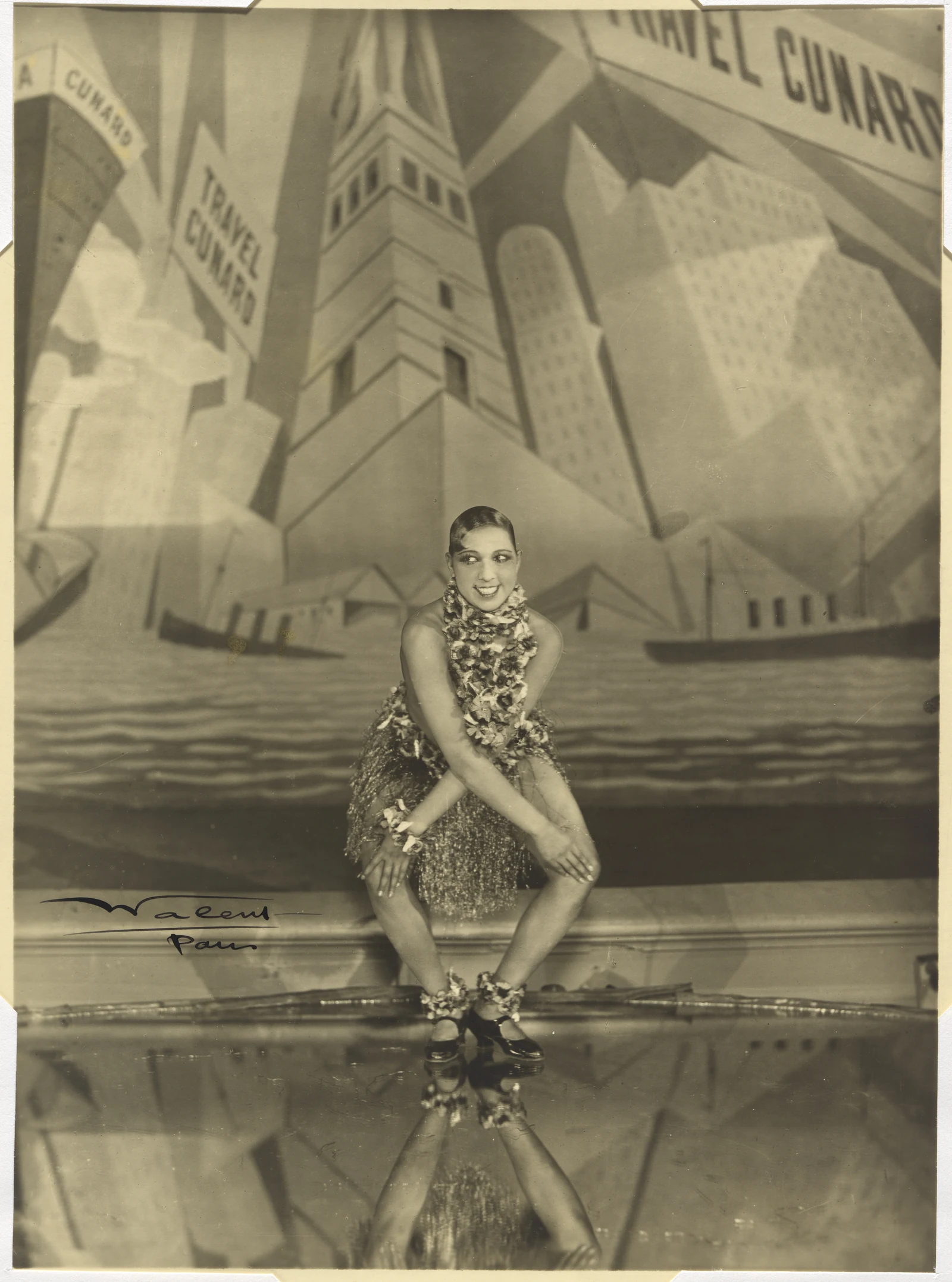
I keep looking at the face. The low stance might first draw attention to her legs; the sideways expression gives that attention another place to go. It is a useful beginning for Greene's choice of the Natural: what looks like an eruption of personality can also be something a performer does with precision.
Greene’s example
The pleasure Greene notices
In The Natural, Greene's third example begins with Baker's 1925 Revue nègre appearance and its Danse sauvage. He emphasizes visible enjoyment, comedy within an erotic dance, and her later freedom to move between public roles. His Natural creates a world of play that other people want to enter. Apparent ease can coexist with a constructed image.[2]
That is the part of the Natural I would test here. A joke can invite an audience to loosen its expectations. It does not certify the performer's innocence, tell us that she never rehearsed, or make her private life available to the people watching.
A pose takes work
The photograph is dated 1926. It cannot show the timing of the 1925 Paris debut, and I would not use it to reconstruct that evening. It gives us something smaller and firmer: bent knees, crossed hands, a turned face, flowers around the neck and ankles, and a pose held for the camera.[1]
Alexandre Sumpf's study for Histoire par l'image describes inflated cheeks, rolling or crossed eyes and comic postures in the 1925 staging. He also places those effects within theatrical direction. His account is a modern historian's interpretation, rather than a surviving film of the premiere; it gives us no reason to assign every gesture to Baker alone.[3]
The surviving publicity has its own maker. Blérancourt holds Paul Colin's 1925 design for La Revue nègre, an oil on plywood cataloged as JP 69 C 5. A performance reaching an audience through an organized revue and a commissioned image is already a collaboration. The design is linked in the sources; its reproduction rights are reserved.[4]
None of these records supplies a rehearsal log for the particular pose in Walery's photograph. They do make it difficult to equate the absence of visible effort with the absence of work. The audience can experience surprise while the performer and her collaborators know how the effect is made.
Who called it instinct?
The word “natural” has a history here that reaches beyond Greene's character. Terri J. Gordon's study of the Parisian reception documents critics explaining Black performance through animality and instinct. She reproduces André Levinson's opposition between intellect and instinct in a hostile Comœdia article of 7 December 1925. These are a critic's racialized categories, not neutral descriptions of Baker's abilities.[5]
Gordon also quotes a reply attributed to Baker: white spectators imagined a forest origin and a frenzy of instinct where she saw the workings of white imagination. Gordon's note identifies the passage in Marcel Sauvage's Voyages et aventures de Joséphine Baker, serialized in L'Intransigeant on 12 October 1930. We encounter Baker's later response through Gordon's quotation and translation, rather than through a newly verified opening-night statement.[5]
That reply changes the question I ask of the smiling face. Whose spontaneity is being described: a performer's chosen effect, or the spectator's ready-made explanation of a Black woman's body? Praising her as instinctive can still remove her from the work of making the performance. Even admiration needs to account for that possibility.
Another room, another reading
The Atlas follows Baker into a different setting. The City of Paris places her debut at the Théâtre des Champs-Élysées on 2 October 1925 and associates J'ai deux amours with her first Casino de Paris recital in 1930. The early revue, the 1926 photograph and the later song belong to separate occasions.[6]
Our Siren profile uses that performed presence as an editorial comparison. It asks what voice, movement, costume and a room shared with listeners make possible. Greene's choice of Baker in the Natural chapter asks a different question: what does playfulness contribute to the encounter? The Atlas's Baker comparison is our placement, not his.
A singer can hold a phrase; a dancer can change the relation between a face and a pose. Those are possibilities of performance. The city's retrospective gives the venue and repertoire, not the length of Baker's pauses or a record of every listener's reaction. I would keep the difference between those forms of evidence visible.[6]
To follow what happens when Baker's presence becomes a portable image, read The Siren and the Star. That feature takes up the printed song cover and the decisions its surviving record leaves unassigned.
Watch the sideways look
For this particular photograph, I find the Natural the more revealing reading. The sideways look interrupts the expectation that Baker will simply present a beautiful body for inspection. Her smile and the crossed hands make the low stance feel like a game she is playing with the camera. That is my reading of the visible arrangement; the photograph does not name the joke for us.
A reasonable reader could give greater weight to the costume, flowers and exposed legs, and place the same image nearer the Siren. The detail I would ask them to return to is the face. Does it deepen the invitation to admire, or make that invitation briefly funny? The disagreement is useful because it concerns something Baker is visibly doing, rather than which single label should stand for her life.
Sources and locators
The notes distinguish Greene’s account, historical records and our interpretation. Image credits and reuse terms appear with the photographs.
- Josephine Baker — Walery, 1926
Locate: NPG.95.105: photograph; Artist, Date, Credit Line and Restrictions & Rights fields; reproduced full frame on this profile.
Supports: The catalog identifies the photographer, sitter, 1926 date and gelatin silver print. The image shows Baker's bent-knee pose, crossed hands and sideways expression.
Scope: Item-level rights: CC0. A still photograph supports a reading of the visible pose, not the speed of a dance, an audience's response or a claim that this is the 1925 debut.
- The Art of Seduction — The Natural, example 3
Locate: Part One → The Natural → Examples of Natural Seducers → example 3, printed pp. 61–63; PDF pages 89–91 (zero-based 88–90). Edition checked on copyright page, PDF page 6.
Supports: Greene uses Baker's 1925 Revue nègre performance and her playful public roles as an example of the Natural.
Scope: The passage was inspected, rather than inferred from a contents page. Greene's narrative is not a contemporary performance record. The linked scan is the consultation copy already documented by this publication; the publisher record identifies the edition.
- Joséphine Baker et la Revue Nègre
Locate: Analyse des images → La Revue nègre, entre caricature et modernité; paragraph beginning Enfin, la publicité du spectacle, on cheeks, eyes and comic postures; Interprétation on staging.
Supports: Sumpf describes comic facial and bodily effects in the 1925 staging and the theatrical direction behind them.
Scope: A modern historian's interpretation of images and staging, not eyewitness footage. It cannot assign the invention of every gesture to Baker. The article's age statement is not used here. Its reserved-rights illustrations are linked, not reproduced.
- La Revue nègre, 1925
Locate: Inventory JP 69 C 5; oil on plywood; artist and origin/date fields; account of the poster commission and troupe.
Supports: A surviving 1925 design documents the deliberate graphic promotion of the revue and its performers.
Scope: The design is evidence of promotion and stylization, not a record of every spectator's feelings. Rights remain reserved; this publication links the object without reproducing its image.
- Synesthetic Rhythms: African American Music and Dance Through Parisian Eyes
Locate: Central discussion of racialized reception and Baker's reply; endnotes 21 and 26. Note 21: Marcel Sauvage, Voyages et aventures de Joséphine Baker, L’Intransigeant, 12 October 1930. Note 26: André Levinson, Comœdia, 7 December 1925.
Supports: Gordon documents critics' racialized explanations of Baker and quotes a later memoir response attributed to Baker.
Scope: The historical press and memoir are mediated through Gordon's research and translations. The original 1930 installment was not inspected for this profile. Baker's later response is not a transcript of her thoughts on opening night.
- Joséphine Baker et Paris, son grand amour
Locate: Opening account of her 2 October 1925 debut; section Au Casino de Paris, Joséphine chante ses deux amours
Supports: The city's account places Baker's Paris stage debut in 1925 and identifies J'ai deux amours with her first Casino de Paris recital in 1930.
Scope: An institutional history records performances and repertoire, not every audience member's desire or Baker's complete private intentions.
Found a broken source or unsupported claim? Report a correction.