An audition story gives us a satisfying moment of recognition. Before treating it as an explanation of a career, I want to know which part of the moment the records can actually support.
The account and its source
What the record confirms
The American Film Institute lists Monroe as Grunion's client in Love Happy. Its catalog separates the San Francisco premiere on 12 October 1949 from the general release on 3 March 1950. These are useful checks on the film and the work she did. They are not a verbatim record of the audition conversation Greene recounts.[2]
Greene also describes a lowered, breathy voice, makeup practice and a cultivated walk, then unrecognized visits to New York bars without the glamorous presentation. His subsection supplies no dated bar visit or named witness. The anonymity story remains his account, rather than a reconstructed public encounter.[1]
His explanation joins deliberately constructed sexual allure to what he reads as innocence and vulnerability. The combination matters to his choice of Monroe as a Siren. His account of her emotional needs is an interpretation; film credits or a photograph cannot establish it.[1]
Greene places her in the Siren. I find the useful question in the work of making a presence: how does a movement become legible to someone watching? An observer's report can describe an effect without settling what the performer meant or everything she wanted from her career.
Taegu, after the last song
A contemporary report gives us a different kind of scene. Pacific Stars and Stripes, datelined Taegu on 20 February 1954, describes the end of Monroe's four-day Korea tour the preceding night. She sings at the Taegu Air Force Open Air Theater. After the show, she returns to the stage to pose for the camera-carrying servicemen gathered in front of it.[3]
That return interests me more than a general claim about her appeal. The song has ended, but the public work continues. Someone must stand where the cameras can see her, sustain a pose and give the photographers an opportunity to take their pictures. A description of the result as effortless can leave those acts out.
The reporter explains the audience's response as “just being Marilyn.” Yet the same report records singing and posing, and ends with a troupe spokesman answering questions about her film career in the context of her Fox contract. Her public appearance and the public account of her future are being handled through different people.[3]
The report does not tell us who planned the photo opportunity or chose her dress. It gives us observable participation without requiring a claim that Monroe controlled the entire occasion. She can be working deliberately within an event whose arrangements and publicity involve others.
The cameras stay in the picture
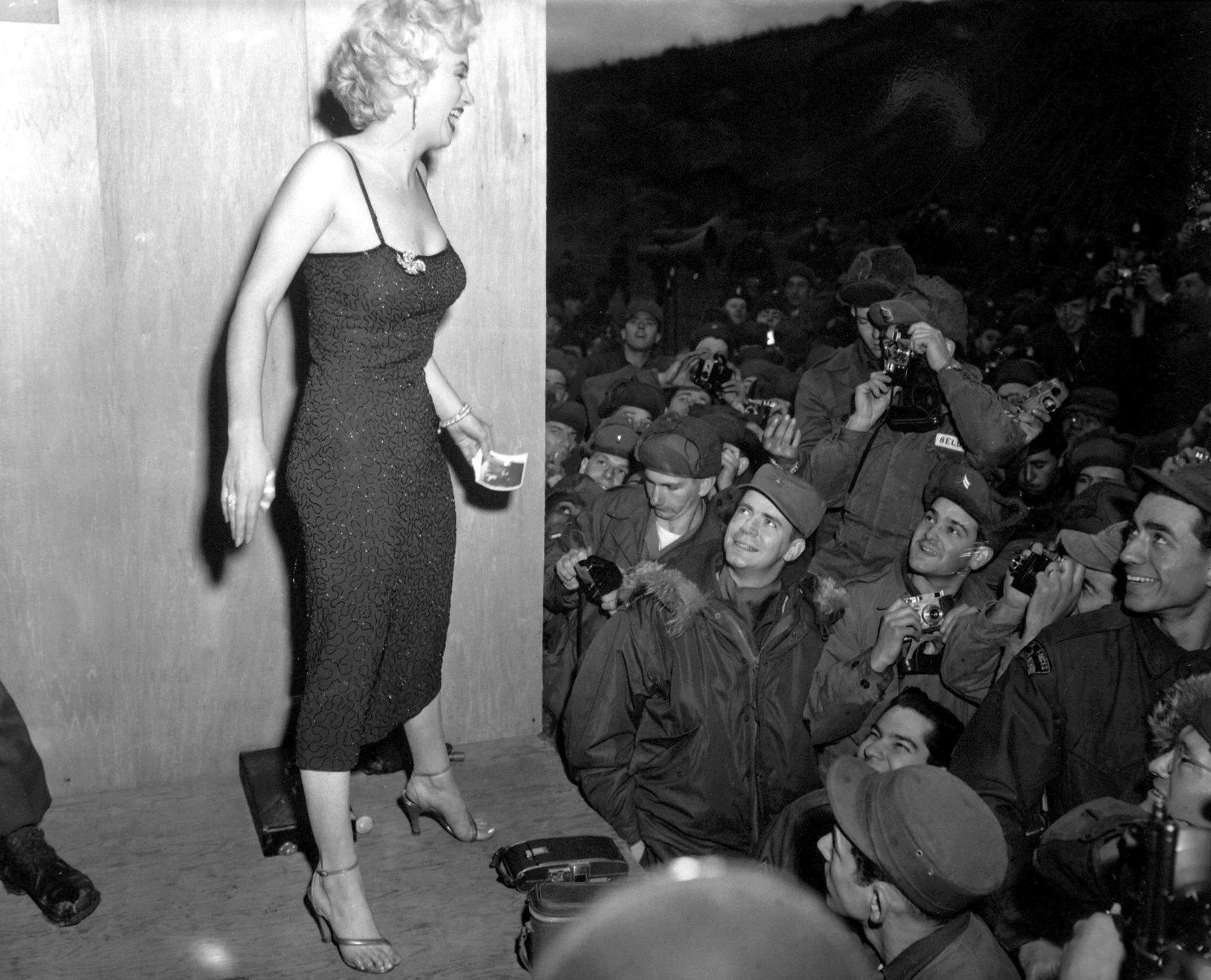
The photograph on this page comes from another stop on the tour. Its Army caption identifies Monroe posing after a performance in the 3rd U.S. Infantry Division area on 17 February 1954. Cpl. Welshman's photograph is held by the National Archives as 111-SC-452342. It is not an illustration of the final Taegu show on 19 February.[4]
Here the cameramen are part of what we see. Some are looking through viewfinders; others look up at Monroe. She stands close to a wall, her arms extended, while the photograph holds performer and photographers in the same frame. This is an encounter being made into pictures, rather than an image that has somehow appeared without anyone doing the work.
The still cannot tell us what she said, how long she held that position or which images she preferred. Its strength is more particular: it records a performed pose and the people photographing it. The report from the later Taegu show and this earlier Army photograph establish separate occasions on which posing followed a performance.[4][3]
Siren work, Star image
The Siren helps me attend to the choices of presentation that an audience encounters at close range. At an audition, a walk is performed for someone. In Korea, singing and posing are work done in front of particular spectators. The concept earns its place when it sends us back to those acts.
The Star becomes a useful editorial connection when the picture travels beyond that encounter. A reader can receive a selected fragment while knowing little about the room, the other cameras or the labor that preceded it. This is our comparison of ways of being seen; Monroe's place in Greene's chapter is the Siren.
Reviewing a photograph and choosing its publication are also different acts. Our feature The Siren and the Star follows Monroe into the later Halsman contact sheets and asks who gets to choose the image that leaves the studio. The Korea records make another part of that problem visible: the performer keeps working while several people are making their own pictures.
Keep the return to the stage
I would keep the return after the song beside Greene's audition walk. Both direct attention to an action. The difference is evidentiary: the walk reaches us through Greene's telling, while a contemporary dispatch reports the return to pose. Neither requires us to treat Monroe as a passive object that happened to attract a crowd.
The Siren is most useful here as a way to look closely at performance. It becomes less useful as a complete explanation of the worker. The cameras, the report and the spokesman's answer bring collaboration, publicity and employment into view. Monroe can make a pose without owning every image or every sentence that other people will make from it.
Sources and locators
The notes distinguish Greene’s account, historical records and our interpretation. Image credits and reuse terms appear with the photographs.
- The Art of Seduction — The Siren, The Sex Siren
Locate: Part One → The Siren → The Sex Siren, printed pp. 9–11, especially p. 10; PDF pages 37–39 (zero-based 36–38). Copyright page: PDF page 6.
Supports: Greene discusses the audition walk, constructed appearance and unrecognized bar visits, and interprets Monroe's appeal through a mixture of allure, innocence and vulnerability.
Scope: These are Greene's accounts. This subsection does not identify a dated bar visit or name a witness to one. Its dialogue and psychological explanation are not independently established by the film catalog.
- Love Happy — AFI Catalog of Feature Films
Locate: Cast: Marilyn Monroe as Grunion’s client; Release Date: 3 March 1950; Premiere Information: San Francisco, 12 October 1949; History and source citations.
Supports: The catalog verifies Monroe's credited role and distinguishes the 1949 premiere from the 1950 general release.
Scope: Film credits and release records establish professional work; they are not a verbatim record of the audition conversation recounted by Greene.
- Marilyn Monroe ends Korea swing
Locate: Opening dispatch: completed four-day tour; final show the previous night at Taegu Air Force Open Air Theater; paragraph beginning After the show; final paragraph on the troupe spokesman.
Supports: The report describes Monroe singing at the final Taegu show, returning to pose after it and a spokesman responding to questions about her film career.
Scope: The preceding-night performance is 19 February. The archive URL is filed under 23 February; the dispatch supplies the 20 February dateline. The article's sexualized rhetoric is the reporter's, not direct evidence of every spectator's response or Monroe's intentions.
- Marilyn Monroe posing after a performance, 3rd U.S. Infantry Division area
Locate: NAID 531435; local identifier 111-SC-452342; Records of the Office of the Chief Signal Officer, Photographs of American Military Activities. Catalog record and digital image; restriction fields also checked through the catalog's JSON endpoint.
Supports: The Army caption identifies Monroe posing for photographers after a performance on 17 February, distinct from the later Taegu event.
Scope: Current item access and use restrictions: Unrestricted. Official Army work, public domain in the United States. The photograph records posing and cameras, not who selected any later publication.
Found a broken source or unsupported claim? Report a correction.